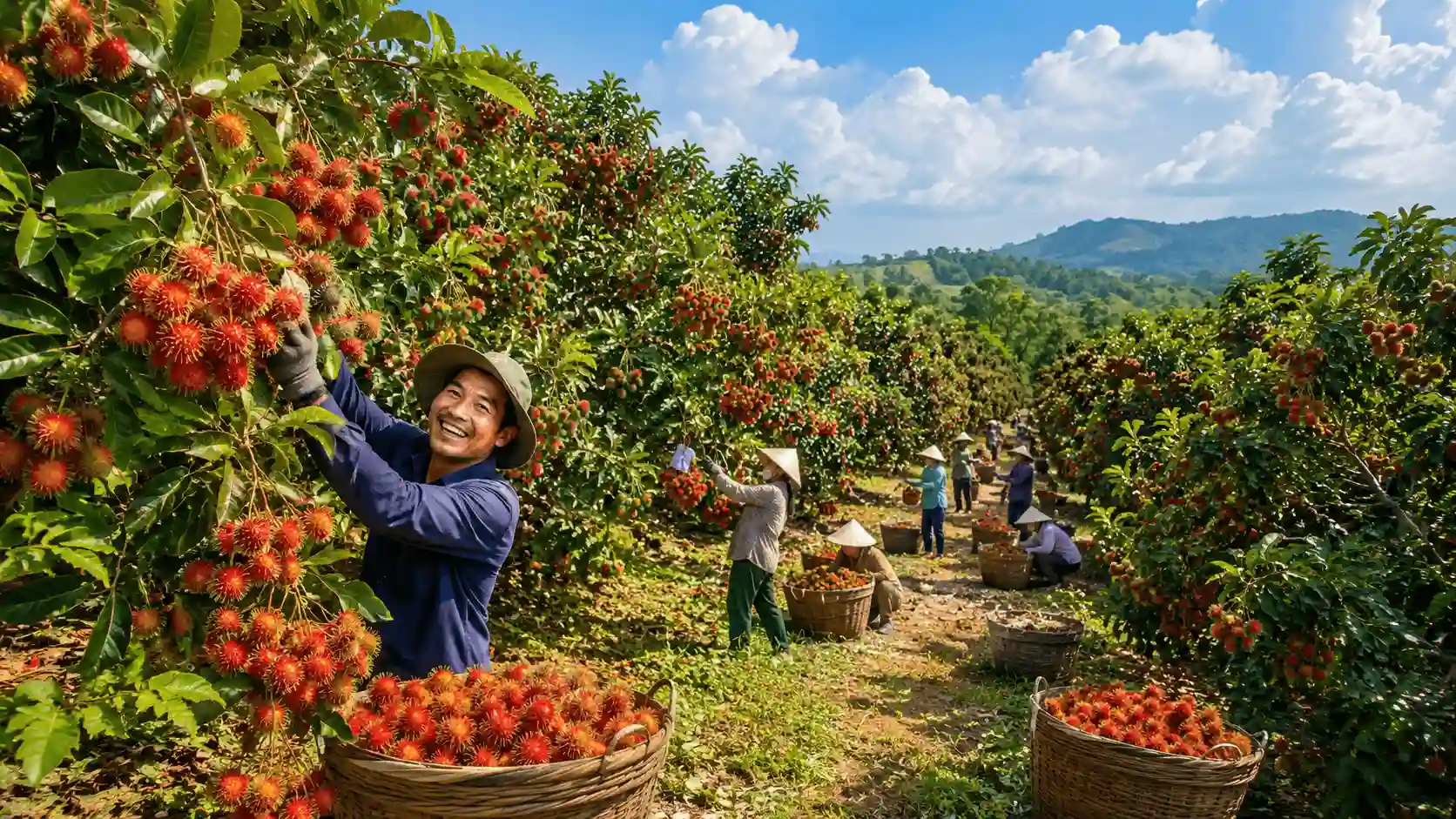
Summer has arrived, and it’s time to enjoy the famous Long Khanh fruit right inside the local orchards, which are now wrapping themselves in a vibrant crimson coat of sun-ripened rambutans. Sitting right under the heavy branches and enjoying fresh fruit straight from the tree has long been a favorite escape for city dwellers.
Sometimes people ask me, “What does Long Khanh even have that makes city folks flock here every summer?” As a child born and raised on the sweet milk of this land, I always answer with pure pride: “Just come. Come to see how vast the old borders of Long Khanh used to be, and to taste the pure sweetness of rambutan and tree-ripened durian grown on our red basalt soil. Only then will you understand why people leave but their hearts stay behind.”
Today, sitting inside a cozy Japanese-style house all the way in Fukuoka, Japan, I want to share the story of Long Khanh with you. Not through dry statistics, but through the rustic, heartfelt memories of a local living far from home.
Long Khanh, Then and Now: What Makes This Land So Unique?
If you were to flip through old maps from before 1975, you might be surprised to find that Long Khanh was not just a town or a city under Dong Nai Province like it is today. Back then, Long Khanh was a large, independent, and proud province of its own!
Officially established on October 22, 1956, the old Long Khanh Province embraced a vast border territory. Its administrative center was Xuan Loc town—which forms the bustling core of modern-day Long Khanh City. Back then, the province was divided into large districts such as Xuan Loc, Dinh Quan, and Kiem Tan (the Gia Kiem area today). It took days just to travel across the entire region.
After 1975, the administrative map underwent a major transformation. In February 1976, three major regions—Bien Hoa, Long Khanh, and Ba Ria (including Vung Tau)—were merged to form the giant Dong Nai Province. Through all the historical ups and downs, even when Ba Ria – Vung Tau later split into its own province, the heart of old Long Khanh remained. It became a unique cultural, historical, and geographical cradle in the eastern part of Dong Nai today.
As a native of Long Khanh, I carry a quiet pride. The name isn’t just a spot on a map; it represents a deep historical journey.
The Tale of Million-Year-Old Volcanoes and the Gift of Red Basalt Soil

Very few people know that the legendary abundance of Long Khanh fruit is entirely nourished by the rich basalt soil left behind by ancient volcanoes from millions of years ago.
There is a geological secret that many travelers—and even some locals—don’t know: the people of Long Khanh are living on top of ancient volcanoes!
Don’t worry, these giants have been fast asleep for millions of years. But before slipping into their eternal slumber, they erupted with scorching lava flows. Over eras of weathering, that molten rock transformed into layers of extraordinarily fertile red basalt earth.
If you drive along the Bau Sen area in Long Khanh, elders will point toward the horizon and say, “That over there is Nui Do (The Red Mountain)!” Indeed, Nui Do is the remnant of a prehistoric volcanic crater. Today, there is no smoke, ash, or lava. The mountain has put on a lush green cloak woven from fruit orchards heavy with yield.
Venturing a bit further toward Dinh Quan and Tan Phu—which used to be part of old Long Khanh—you will encounter deep lava tubes (like the Bat Cave) winding far beneath the earth. Scientists consider this one of the longest lava tube systems in Southeast Asia. You will also see mounds of glossy black basalt rocks sitting right in the middle of local black pepper and coffee farms around Gia Kiem. It is this one-of-a-kind geological foundation that shapes the unmistakable flavor of Long Khanh fruit.
Lost in the “Fruit Capital” of Southern Vietnam: What to Eat?
They say birds flock to fertile lands, but in Long Khanh, fertile land brings sweet fruit. The fruit here tastes incredible because the roots drink deep from the volcanic basalt womb and the trees soak up the characteristic sun and breeze of the highlands. If you happen to visit Long Khanh during the harvest season (from May to August of the lunar calendar), you absolutely must try our “Royal Trio”:
1. Long Khanh Rambutan: Crispy, Dry, and Clean Sweetness
This is our number one pride and the very first fruit in the region to receive a Geographical Indication certificate. Rambutans grow everywhere, but Long Khanh rambutans (especially the Chôm Chôm Tróc Nhãn and Thailand varieties) are truly special. Because the highland soil drains beautifully and never gets waterlogged, the fruits ripen into a brilliant crimson. Once peeled, the translucent flesh is thick, dry, and delightfully crispy rather than watery and messy. One bite delivers a deep, clean sweetness that lingers on the tip of your tongue—you can eat dozens without ever getting tired of them.

2. Long Khanh Durian: Rich, Creamy, and Soul-Stirring
The Ri6 and Thai durian varieties grown on this rocky volcanic soil yield pods that are a striking, buttery golden yellow. In the late afternoon, as you pass through Binh Loc or Bao Quang communes, the aroma of tree-ripened durian drifts on the breeze, finding its way into every small alleyway. Long Khanh durian features a beautifully sticky texture, a profoundly rich creaminess, and a sweetness like pure honey. Anyone who loves durian will simply forget the way home.
3. Tố Nữ Jackfruit: The Queen of Exotic Aromas

The Tố Nữ jackfruit is relatively small, only about the size of an adult’s thigh, but it packs an unforgettable punch. When ripe, its fragrance travels for dozens of meters—if you stand downwind, it catches you instantly. The most delightful part of eating this Long Khanh fruit is slicing it open vertically, grabbing the stem, and gently pulling it upward. The entire cluster of golden-orange pods comes away cleanly from the outer rind. Pop a pod into your mouth, and let the intensely sweet, rich flavor melt away into pure bliss.
An Invitation from a Local
If there comes a day when you feel weary from the dust and clamor of city life, catch a ride to Long Khanh. Why come here? Come to hand-pick crimson rambutans still glistening with morning dew. Come to sit under the cool canopy of a centuries-old durian tree, listening to the elders tell stories of the land and its people from the days when Long Khanh was just a faraway province.
Our Long Khanh is simple and rustic like that, but the warmth of the people and the sweetness of the fruit are always overflowing. Don’t forget to visit Long Khanh during the harvest season, my friends!