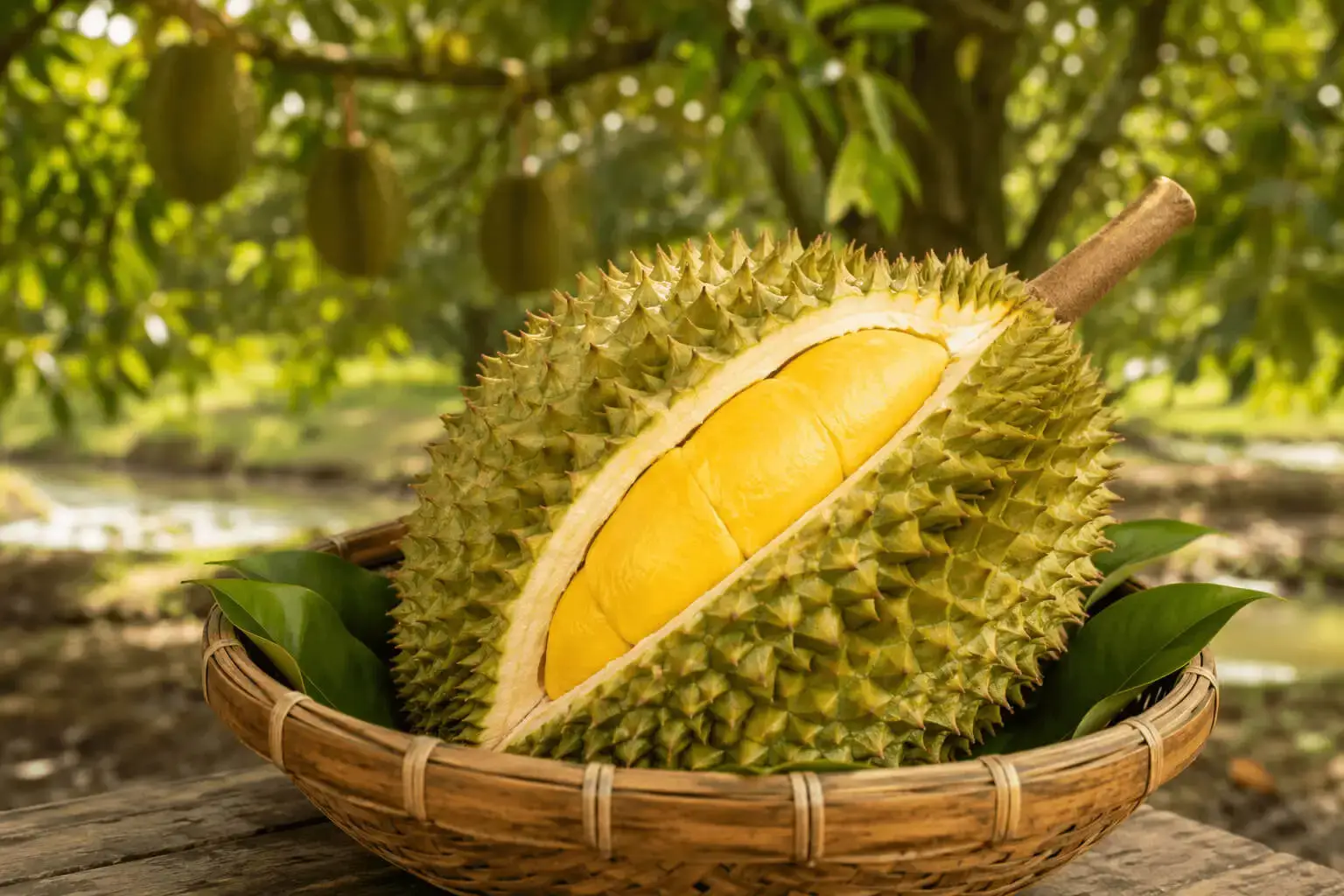
Delving into Vietnamese durian history reveals a fascinating journey. Though originating from maritime Southeast Asia, durian has long reigned as the undisputed “King of Fruits” in Vietnam, driving locals into a frenzy every harvest season.
If you dig into the history of Vietnamese durian, you will stumble upon a delightful truth: it is not a native species. The ancestors of this royal fruit actually came from the islands of Southeast Asia, scattered across countries like Malaysia and Indonesia. However, the journey of this “finicky lady” taking root and becoming an irreplaceable crown jewel on Vietnam’s culinary map is a century-long saga filled with fascinating twists.
A Century-Old Migration: From Monastery Gardens to Cambodian Royalty
Stepping back in time to the 1910s, durian took its first steps into Vietnam through two distinct, legendary routes.
The first path led to the Tan Quy area, located in modern-day Bien Hoa, Dong Nai province. Legend has it that a French priest painstakingly brought the very first saplings all the way from Indonesia to plant them as an experiment. Befitting the soil and weather of the East, the trees flourished beautifully.
Around the same time in the West (the Mekong Delta), a schoolteacher named Nguyen Duy Lưu traveled to Cambodia to tutor the royal family. Captivated by a strange fruit with a rich, sweet, milky flavor, he fell in love with it and brought the seeds back to his hometown of Cai Mon in Ben Tre province to cultivate. The legendary “Sữa Bò” (Cow’s Milk) durian variety—famed for an era—was born from that serendipitous encounter.
From scattered trees lining backyard fences or tucked away in the orchards of wealthy families, durian quietly boomed. By the late 1990s, Mr. Sau Ri in Vinh Long province successfully bred the iconic “Ri6” variety—celebrated for its golden, dry, and sweet flesh with flat seeds. Shortly after, the “Monthong” (Dona) variety was introduced from Thailand. With these milestones, durian officially entered its golden age, transforming ordinary farmers into overnight billionaires.
Raising a Durian Tree: Pampering a High-Maintenance Lady

Locals often joke that caring for a durian tree is like pampering a high-maintenance lady: “She hates the blazing sun, can’t stand the pouring rain, detests the wind, and fears the frost.” To bring those premium, high-priced ripe fruits to the market, farmers have to trade countless sleepless nights.
Durian trees absolutely dread waterlogging in the rainy season, yet easily wither during the dry months. When the flowering season arrives, growers must stay awake through the night, holding small brushes to manually pollinate each blossom to ensure the fruits don’t grow misshapen. Later, when the fruits grow to the size of a chicken egg, farmers have to make a heartbreaking choice: manually thin out two-thirds of their hard work, plucking off young flowers and baby fruits so the tree doesn’t deplete its energy.
During stormy days, looking at branches heavy with fruit can make a farmer’s heart burn with anxiety. They have to climb up high branches, using strings to meticulously tie each individual fruit to the tree trunk to prevent them from falling in the wind. Even the harvest requires “durian-tapping artisans.” Armed with a small knife, they gently tap the rind; a hollow “bop bop” or thudding “bich bich” sound tells them exactly if the fruit is perfectly mature. Harvesting even one day too early can ruin the entire batch, flushing months of labor down the drain.
“Pricey but Worth It”: An Unexpected Nutritional Powerhouse
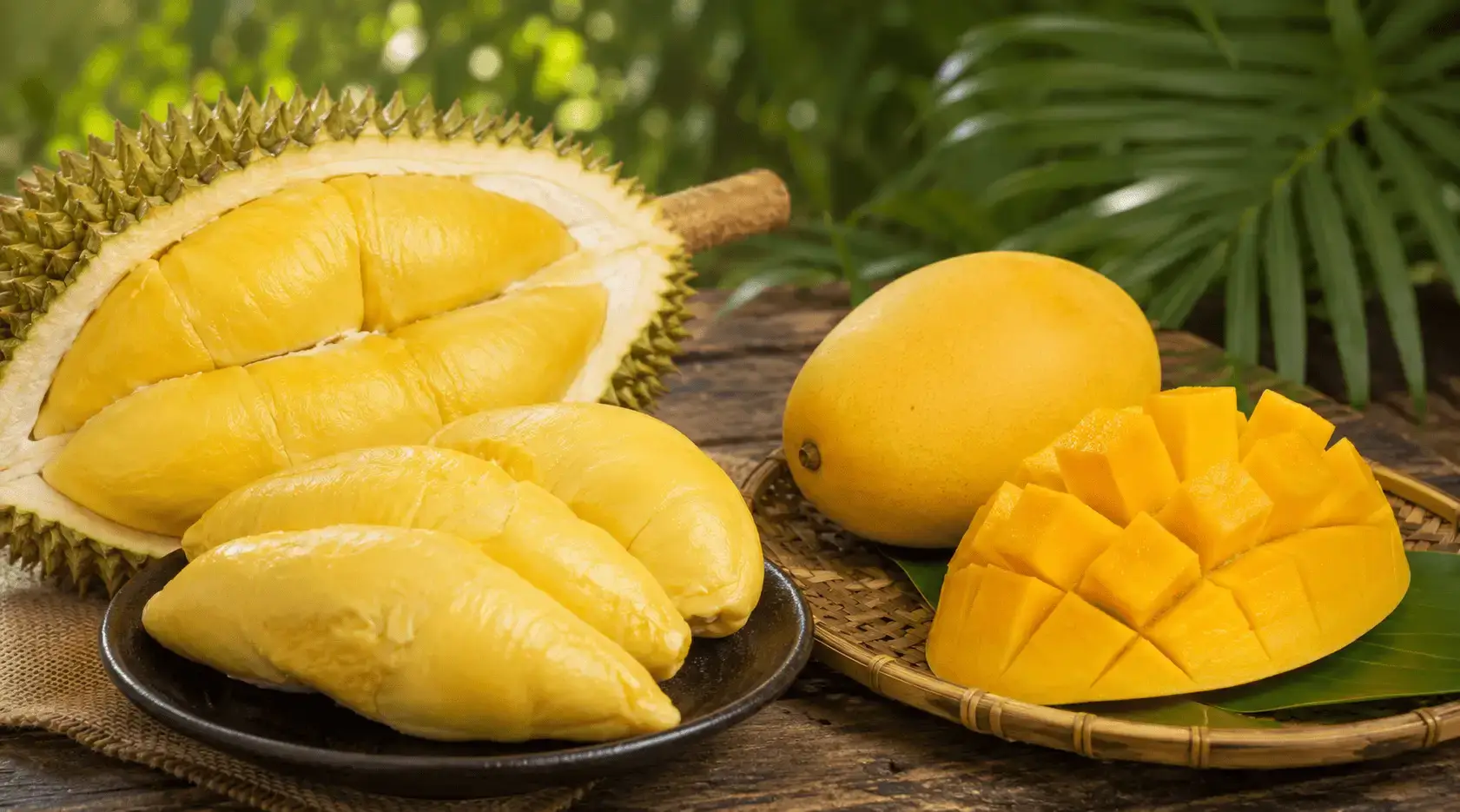
Durian is undeniably expensive, but the nutritional value it packs is arguably the most concentrated in the fruit kingdom. People often wonder: Does eating a single pod of durian equal eating a whole ripe mango?
If we put them on a scale, a large durian pod (around 100g) contains a whopping 147 calories, outclassing a medium-sized Hoa Loc mango (about 200g, which only yields around 120 calories). While the sugar content in a pod of durian is roughly equivalent to a whole mango, durian completely dominates when it comes to healthy fats and essential minerals like Potassium. Consequently, eating just about three pods of durian can refuel your body with the energy equivalent to a full main meal.
Calories aside, durian is a wonderful mood booster. It contains tryptophan, an amino acid that converts into happiness hormones once inside the body, helping you relax, reduce stress, and sleep better. However, too much of a good thing can backfire. To avoid internal heat, it is best to limit yourself to 1–2 pods per sitting, and absolutely avoid drinking alcohol, beer, or carbonated soft drinks while indulging.
A Scent That Divides Senses
No other fruit on Earth evokes such fierce extremes of love and hatred. Those who love it describe it as intensely fragrant, rich, and seductive; those who cannot stand it (including many Westerners and Japanese) view it as an absolute nightmare.
Science has proven that as durian ripens, it simultaneously releases two opposing groups of compounds: esters that create a sweet aroma of caramel and honey, and sulfur compounds that smell strongly of onions and garlic. For people in Southeast Asia or China, who grew up accustomed to deep, bold flavor profiles, the brain automatically filters out the sulfur notes, leaving only the sweet, creamy richness. Conversely, the olfactory senses of people from colder climates, accustomed to light and subtle scents, are instantly overwhelmed by that concentrated sulfur smell.
Personally, I am quite faithful to this fruit, though in a quirky way: I am utterly obsessed with the aroma of durian, but I don’t actually enjoy eating it raw. Ripe durian inherently “lacks” acidity or astringency—the elements that balance out the palate. When you take a bite, the intense sweetness and rich fat instantly coat the mouth, leaving sugar-sensitive people like me feeling a bit overwhelmed. If you are like me, try eating frozen durian or sipping a small piece alongside a cup of strong green tea. The pleasant bitterness of the tea beautifully neutralizes the sweetness, making the durian taste remarkably better.
The Volcanic Soil of Long Khánh: Where Flavors Peak
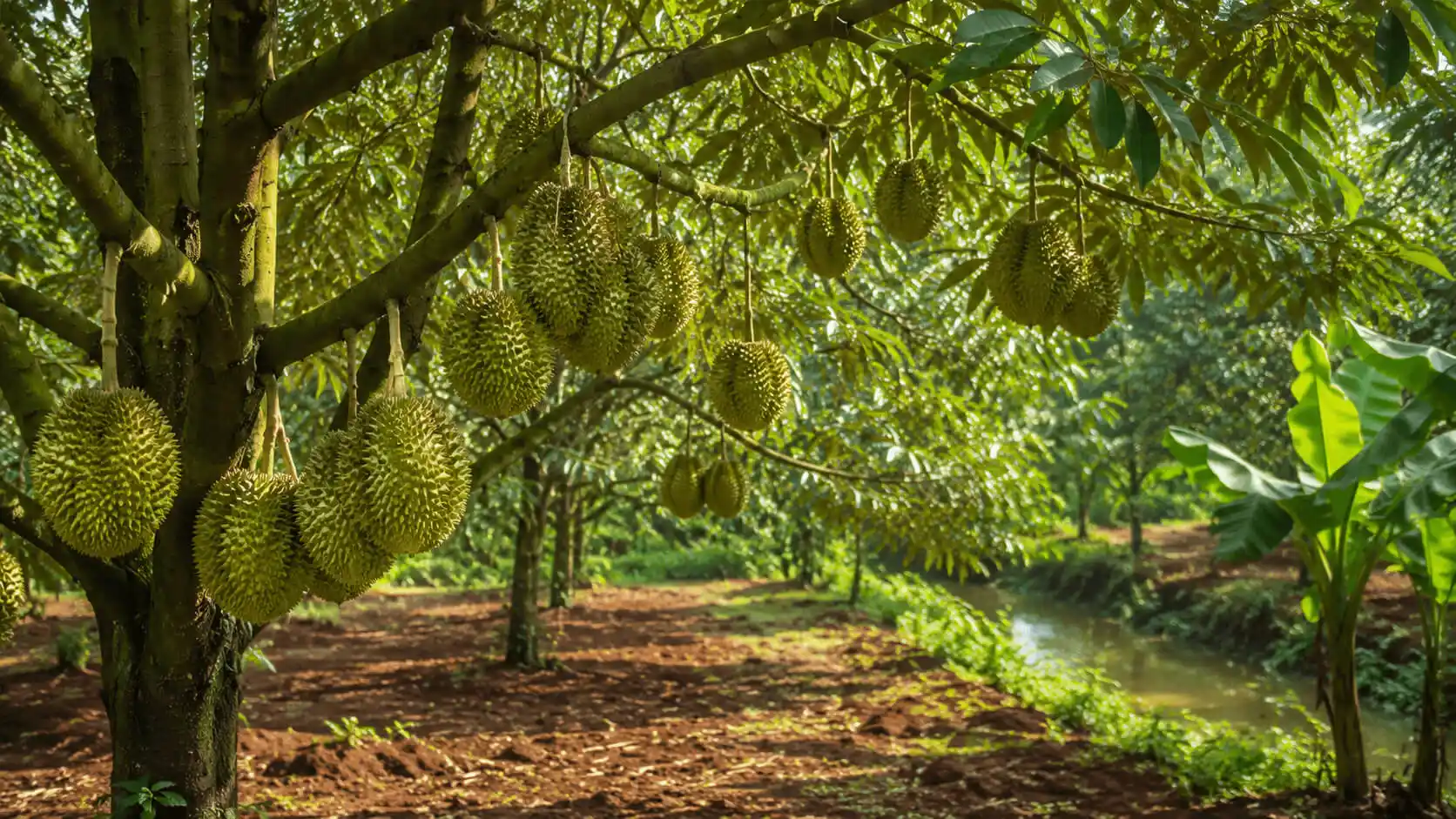
Having traveled to many places and tasted various kinds, I still crown the durian grown on the ancient red basaltic soil of Long Khanh (Dong Nai) as the ultimate king. It’s not just durian; the rambutan, jackfruit, and avocados from this volcanic land all carry a uniquely deep, rich, and lingering aftertaste. The rich minerals left behind by ancient volcanic lava, combined with the intense heat of the eastern dry season, concentrate the sugars, making Long Khanh durian flesh exceptionally smooth, dense, and buttery without becoming watery.
However, there is a fascinating exception: if it’s mangosteen, I won’t choose Long Khanh. The “shy lady” mangosteen does not thrive in the aridness of red soil; she prefers the humid, water-rich environment of alluvial riverbanks like Lai Thieu or the Mekong Delta islets. Only there does the mangosteen develop a paper-thin rind, snow-white segments, and that perfectly refreshing sweet-and-sour balance.
Nature works in beautiful ways; each plant chooses its own piece of earth to manifest its purest essence. And durian, after its century-long migration, chose the soil of Vietnam to write its own proud, majestic story of royalty.